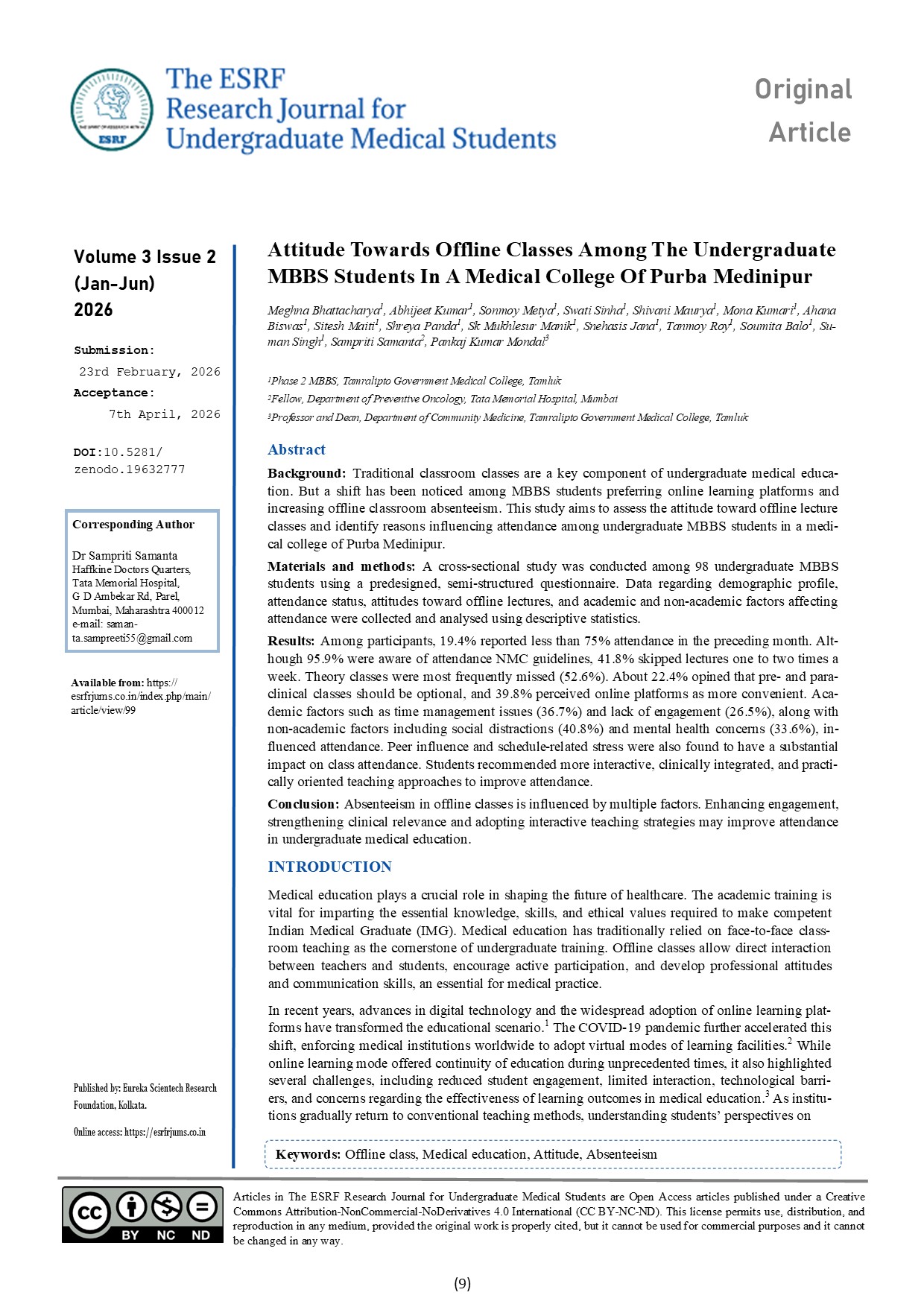
Attitude Towards Offline Classes Among The Undergraduate MBBS Students In A Medical College Of Purba Medinipur
Article Sidebar
Main Article Content
Abstract
Background: Traditional classroom classes are a key component of undergraduate medical education. But a shift has been noticed among MBBS students preferring online learning platforms and increasing offline classroom absenteeism. This study aims to assess the attitude toward offline lecture classes and identify reasons influencing attendance among undergraduate MBBS students in a medical college of Purba Medinipur.
Materials and methods: A cross-sectional study was conducted among 98 undergraduate MBBS students using a predesigned, semi-structured questionnaire. Data regarding demographic profile, attendance status, attitudes toward offline lectures, and academic and non-academic factors affecting attendance were collected and analysed using descriptive statistics.
Results: Among participants, 19.4% reported less than 75% attendance in the preceding month. Although 95.9% were aware of attendance NMC guidelines, 41.8% skipped lectures one to two times a week. Theory classes were most frequently missed (52.6%). About 22.4% opined that pre- and paraclinical classes should be optional, and 39.8% perceived online platforms as more convenient. Academic factors such as time management issues (36.7%) and lack of engagement (26.5%), along with non-academic factors including social distractions (40.8%) and mental health concerns (33.6%), influenced attendance. Peer influence and schedule-related stress were also found to have a substantial impact on class attendance. Students recommended more interactive, clinically integrated, and practically oriented teaching approaches to improve attendance.
Conclusion: Absenteeism in offline classes is influenced by multiple factors. Enhancing engagement, strengthening clinical relevance and adopting interactive teaching strategies may improve attendance in undergraduate medical education.
Downloads
Article Details
Section

This work is licensed under a Creative Commons Attribution-NonCommercial-NoDerivatives 4.0 International License.
How to Cite


